



11 Mar Ashtanga, Embodiment and Complex Systems
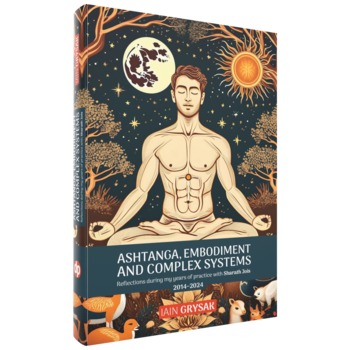
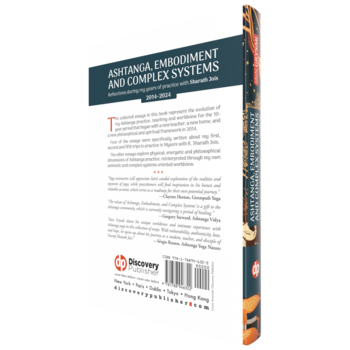
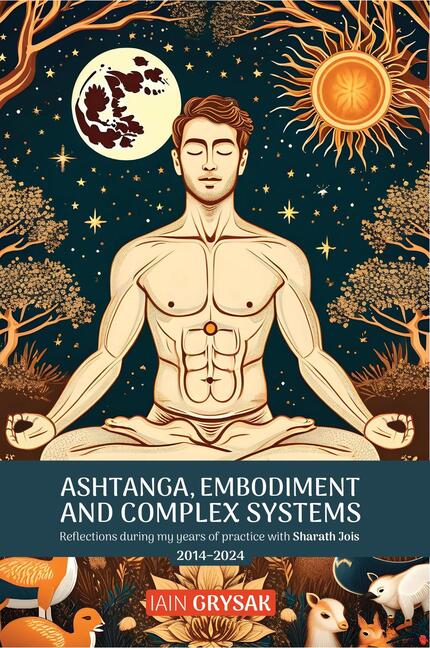
In this deeply intimate collection of essays, Iain Grysak opens the doors to his inner world, chronicling a decade of profound physical and spiritual metamorphosis. From his fervent desire to experience the magic of Mysore alongside his late teacher, Sharath Jois, to the humid, silent pre-dawn hours of his Balinese shala, the author writes with rare vulnerability and raw authenticity.
Steering far clear of the superficiality of modern yoga culture, Iain invites us on a magnificent journey into the very heart of flesh and breath. Through the poetry of animism and the wondrous reality of our material existence, the Ashtanga practice ceases to be a mere physical discipline and becomes, instead, a visceral communion with the Earth. By teaching us how to embrace discomfort and adversity with an open heart, this vibrant work offers a profound testament to the transformative power of the practice—whispering a luminous promise of hope, radical autonomy, and positive evolution for our shared humanity.
“A remarkable and sensitive book that weaves together a rich narrative about the embodied experience. Drawing on diverse resources from yoga to vipassana, systems theory, biology, psychology, environmental science, and phenomenology, Iain offers a nuanced exploration of what it means to be human.” —Andrew Alexander Davis, Professor of Philosophy, Belmont University
TECHNICAL INFORMATIONS
Page count
388
Format
6 x 9 in
ISBN
Paperback: 9781788946322
Hardback: 9781788946339
Price (suggested, in USD)
Paperback: 19.90
Hardback: 24.90
eBook: 9.90
SALES OUTLETS
LOOK INSIDE

Praise for Ashtanga, Embodiment and Complex Systems
➤ Upon diving into Iain’s book, I found myself fully absorbed and unable to put it down. Having shared similar experiences with influential figures like Sharathji Jois and Rolf Najokat, I felt a strong connection to Iain’s narrative, resonating deeply with his insights and reflections. The book chronicles his journey from his initial trip to Mysore to his later practice at Sharath’s shala in Hebbal, offering a fascinating glimpse into the evolution of his thoughts and perceptions over time. Yoga instructors will appreciate Iain’s candid exploration of the realities and mysteries of yoga, while practitioners will find inspiration in his honest and relatable account, which serves as a roadmap for their own potential journey. —Clayton Horton, Senior Ashtanga Yoga Instructor, Greenpath Yoga
➤ Iain Grysak’s ‘Ashtanga, Embodiment, and Complex Systems’ offers a profound and timely contribution to yoga literature. The author’s lived experience shines through in his writing, providing dogma-free insights into the practice that resonate deeply with my own twenty-year journey with Ashtanga yoga and meditation. What struck me most about this collection was its ability to put into words sensations and experiences I’ve had but struggled to articulate. Iain’s clear, vivid descriptions helped me connect the dots between my practice, my sense of self, and the world around me. This book is more than just a personal reflection—it offers a quiet hope that through authentic embodied encounters with reality, we can find a viable path forward for both individuals and our species. The release of ‘Ashtanga, Embodiment, and Complex Systems’ is a gift to the Ashtanga community, which is currently navigating a period of healing. But its significance extends far beyond this community, speaking to anyone interested in yoga, meditation, or personal growth. I believe this book will continue to give back to readers for years to come, offering a rich source of inspiration and guidance on their own paths towards greater awareness and understanding. —Gregory Steward, Senior Ashtanga Yoga Instructor, Ashtanga Vidya
➤ Iain Grysak shares his unique worldview and intimate experience with Ashtanga yoga in this collection of essays. With vulnerability, authenticity, love, and hope, he opens up about his journey as a student, teacher, and disciple of Guruji Sharath Jois. Through his writing, Iain shows that consistent dedication to an Ashtanga practice can restructure both body and mind. Moreover, by embracing difficulties with an open heart, we can navigate the challenges that arise on our spiritual paths. Iain’s essays offer a powerful reminder that humanity has the potential for growth and positive change. His work is a testament to the transformative power of yoga and meditation, and his message is one of hope and encouragement. By sharing his insights and experiences so openly, Iain invites readers to embark on their own journey of self-discovery and spiritual exploration. —Sérgio Ramos, Ashtanga Yoga Nazare
➤ Iain Grysak’s ‘Ashtanga, Embodiment and Complex Systems’ is a remarkable and sensitive book that weaves together a rich narrative about the embodied experience. Drawing on diverse resources from yoga to vipassana, systems theory, biology, psychology, environmental science, and phenomenology, it offers a nuanced exploration of what it means to be human. Despite the theoretical depth, Grysak’s focus remains firmly grounded in practice, examining how we live, move, breathe, heal, listen, and respond to ourselves and others. A core insight that emerges is that relationships between entities are more significant and real than individual components alone. Starting from various postures or concepts within Ashtanga yoga, these essays expand into a comprehensive vision of bodily and earthly experience. I highly recommend this book to anyone interested in yoga, meditation, nature, or embodiment, as it offers a unique and thought-provoking perspective on the interconnectedness of human experience. —Andrew Alexander Davis, Professor of Philosophy, Belmont University
➤ This collection of essays bears witness to Iain’s ongoing evolution, exploring the intricate complexities of a practitioner’s personal and collective realities, embedded within the dynamically interconnected systems shaping our world. Rather than adhering to any cultural narrative or echo chamber, Iain advocates for developing one’s unique organic and adaptive identity, at the intersection of decentralized processes that challenge the pursuit of an unattainable perfect state. Instead, he leans towards self-realizing embodied paths which naturally reconcile apparent contradictions. Interconnectedness has it that in 2003 I introduced Iain to Ashtanga yoga after meeting at a meditation retreat. After just a few sessions with an early Western teacher in the Mysore-style practice, he fully committed himself to this path and has since become one of today’s most profound and knowledgeable yogis. —Sébastien Arcand-Tourigny D.O., Osteopath, Yogi and Musician
Philosophical Synthesis: Ashtanga Yoga and the Path of Inner Integration
1. Introduction: From Conceptual Dogma to Embodied Reality
The trajectory of Iain Grysak’s work maps a profound recalibration of the sentient self, moving from the rigid, institutional hierarchies of traditional Theravāda Buddhism (specifically the Goenka Vipassanā association) toward an integrated, animistic, and systems-based framework. This transition was catalyzed by the critical insights of The Guru Papers, which facilitated a rejection of “strict paratexts”—the external dogmatic scripts that often stifle original spiritual inspiration.
The primary movement is one from “Transcendence”—the ascetic drive to seek liberation from the world—to “Immanence,” where integration is found within the lived organism and its environmental context.
Key Shifts in Perspective:
- From Dogma to Direct Experience: A rejection of institutionalized hierarchies in favor of a decentralized, adaptive identity rooted in the wild.
- From Transcendence to Immanence: Shifting the spiritual goal from world-denial to a somatic reconciliation with the present, material reality.
- From Human-Centric to Animistic: A transition from viewing the human as a sovereign subject to recognizing the human as an interconnected node within a larger, non-human system (Gaia).
- From Reductionist Mastery to Systems Transformation: Moving away from the “accumulation” of postures and toward the autopoietic restructuring of the somatic architecture.
2. Organic Intelligence and the Sentient Body
Central to this synthesis is the tension between the “Conceptual Mind” and the “Sentient Body.” In modern civilization, the conscious mind often retreats into a sterilized world of ideas, becoming deaf to the “Organic Intelligence” of the lived organism. Authentic practice functions as an exploration relationnelle (relational exploration), fostering a dialogue between the ressenti de soi (the felt self) and the conscience de soi (self-awareness).
The Conceptual World of Ideas The Organic Intelligence of the Body Reductionism: Views the body as a machine to be manipulated or a collection of isolated parts. Systems-Thinking: Views the organism as a cohesive, autopoietic whole. Isolation: Operates within an artificial, human-centric world of mental abstractions. Reciprocal Communication: Rooted in the innate somatic architecture and sensory reciprocity with the world. Dominance: Seeks “the most comfortable way” to silence somatic messages or satisfy the ego’s ambition. Dialogue: Engages in a non-reactive, continuous communication through subtle fluctuations in sensation. Accumulation: Prioritizes titles, technical mastery, and “perfect” external forms. Integration: Prioritizes the deepening of internal relationships and structural alignment.
3. Systems Thinking vs. Reductionism in Yoga Practice
By applying Systems Theory and the concept of Autopoiesis—the ability of a system to produce and maintain itself—we can redefine the Ashtanga sequence. It is not a mere workout, but an autopoietic system that regenerates the practitioner’s internal environment through the rhythmic interplay of breath and movement.
- Emergent Properties: The sequence functions as a level of higher organization. The healing effects of the practice are “emergent properties”; they do not exist in individual postures (the parts) but arise from the dynamic interaction of the entire system.
- The Tree Analogy: Structural change cannot be aggressively coerced. Just as a gardener cannot force a tree to grow but can only provide the micro-adjustments to its environment, the practitioner allows the body to recalibrate. Durable transformation requires time for the musculoskeletal, nervous, and endocrine systems to find a new equilibrium together. If the ego imposes change too rapidly, the system “breaks or dies.”
4. Somatic Awareness and the Architecture of Non-Reactivity
This philosophy synthesizes the technical precision of Vipassanā with the somatic rigor of Ashtanga, viewing the body as a repository of Samskāra/Sankhara (mental imprints or traces of past reactive patterns).
- Key Definitions:
- Upekkha (Equanimity): Maintaining a stable, equal mind amidst pleasant, unpleasant, or neutral sensations.
- Sampajañña (Clear Comprehension): A lucid awareness of the present, specifically linked to the physical architecture of the “midline” alignment.
- The Psychological Ruse: The Mysore method’s “Stop There” (Tu t’arrêtes là) philosophy is a strategic intervention. For years, Grysak used his own “lordosis” and “pelvic tilt” as intellectual ruses—anatomical excuses to avoid the deeper somatic work of Dwi Pada Sirsasana. By being “stopped” at this posture, he was forced to encounter his internal resistance, transforming the mat into a laboratory for objective observation.
Three Typical Reactions to Difficulty:
- Abandonment/Repression: Bypassing the transformative lesson by stopping the practice or seeking a more “lenient” teacher who will not challenge the resistance.
- Distortion/Aggravation: Forcing the somatic architecture into an idealized form for the sake of “performance,” which reinforces negative samskāras and invites injury.
- Objective Observation: Listening to the lived organism with sensitivity, allowing the structure to evolve naturally through non-reactive persistence.
5. Animism and Interconnectedness: The Human in the Non-Human World
Drawing upon the phenomenology of David Abram, we recognize that our senses did not evolve in a vacuum but through “sensory reciprocity” with the non-human world. Isolation from this earthly context causes systemic imbalance.
“Our sensory organs and our nervous system have evolved over millions of years to enter into contact with the non-human world… Denying this vital part of our heritage and our being… is equivalent to denying a part of ourselves.”
The “Bear Encounter” serves as a definitive case study in the flip from human-centric to animistic perception. In the wild, the human is not merely the sovereign “Subject” perceiving an “Object.”
“Nature is endowed with intelligence and can perceive us, even the trees and the rocks… I was an object, an element in its quest for food… I had witnessed a theft well-planned and executed by a being gifted with intelligence and consciousness.”
In this realization, the bear became the intelligent “Subject,” and Grysak became the “Object” of the bear’s tactical analysis. This vulnerability is the cornerstone of an “Earthly Cosmology.”
6. The Dynamics of Integration: Tension, Stability, and Healing
Physical healing is an exercise in Tensegrity—the structural integrity maintained through the balance of tension and compression.
- Sukha and Sthira: Sukha (ease) is the capacity for relaxation within effort, while Sthira (stability) is the capacity to maintain attention without being destabilized by internal or external pressures.
- The Lesson of Ambition: The author’s injury during Karandavasana was a failure of tensegrity. Driven by “ambition” and “performance,” he overrode the “Organic Intelligence” of his body, resulting in a nerve compression and segmental displacement between L5 and S1. This was a systemic response to the ego’s attempt to bypass the necessary time for structural integration.
- The Goal of Practice: The ultimate aim is to align the line médiane (midline) of the body with gravity. By correcting chronic tensions—the physical manifestations of our struggle against the earth’s pull—we move from “performance” to a holistic, integrated presence.
7. Conclusion: The Evolutionary Responsibility of the Practitioner
The synthesis of these disciplines offers a “quiet hope” for the future. Authentic yoga suggests that through embodied encounters with reality, we may discover a viable path forward for our species. The evolutionary responsibility of the practitioner is to move beyond the reductionist and dogmatic traps of modern spirituality, embracing a world where we are fully reconciled with our somatic architecture.
Inner integration is the somatic reconciliation of the conscious mind with the sentient body, a process of aligning human architecture with the gravity of the Earthly cosmology.
Ashtanga, Embodiment and Complex Systems
The essays represent the evolution of Iain Grysak's Ashtanga practice, teaching and worldv...
The Four Paths of Yoga
Vivekananda’s guide to the Spiritual Paths and practitioner’s guide to the four spirit...
The Four Paths of Self-Realization
Vivekananda’s guide to the Spiritual Paths and practitioner’s guide to the four spirit...
The Philosophy of Wellbeing
Throughout The Philosophy of Wellbeing, for Her, William Walker Atkinson's unique objectiv...
Hatha Yoga
Throughout The Philosophy of Wellbeing, for him, William Walker Atkinson's unique objectiv...

The Philosophy of Wellbeing
Throughout The Philosophy of Wellbeing, for Her, William Walker Atkinson's unique objectiv...